However, some of the tuition is conducted online.

Friday, November 20, 2020
Tuition and nursery education not allowed in Sri Lanka although schools reopen next week
The Secretary to the Ministry of Education of Sri Lanka Prof. Kapila Perera said that the tuition and the nursery education was not allowed in the country although shools outside Western Province would be open from November 23.


No trains in Sri Lanka during the weekend
Sri Lanka Railway will suspend all train travels in the island during the weekend of November 21 and 22 to stop the spread of COVID-19.
Sri Lankan travelers no need to self-isolate on arrival in England
Sri Lanka was added to England's safe travel list on Thursday, November 19th.
Travellers from Sri Lanka will no longer have to self-isolate on arrival in England from Saturday November 21st.
The other countries that were newly included to this facility are Namibia, Rwanda, Bonaire, St Eustatius & Saba, the Northern Mariana Islands and the U.S. Virgin Islands.
Sri Lanka does not provide this facility to any country.
Budget deficit figures in 2021 budget proposals in Sri Lanka wrong - FactCheck

Quoting annual reports from the Ministry of Finance, Fact Check Sri Lanka said, "It is incorrect to compare a value of 5.7% in 2014, which does not account for unpaid claims, against a figure of 8.4% in 2019, which accounts for unpaid claims. It is also inaccurate to calculate the budget deficit by considering unpaid claims in expenditure without applying the same basis to revenue".
Rajapaksa said in the budget speech, "…the budget deficit which my government brought down to 5.7 percent of Gross Domestic Product (GDP) in 2014, has increased to over 9.6 percent of the GDP by 2019… outstanding unpaid bills amounted to Rs. 243 billion, while the foreign debt financed expenditure amounted to Rs. 212 billion remained unaccounted […which] resulted in the reported budget deficit for 2019."
Opposion MP Dr. Harsha de Silva said in a tweet that the Secretary to the Treasury was finally responsible for this kind of errors. He pointed out that he had raised it with him at the Committee on Public Finance while the official tried to justify it."
Read the Fact Check report here >>
Thursday, November 19, 2020
Will Sri Lanka lose GSP+ again?

(Opinion by Ajith Perakum Jayasinghe, Editor) European Union (EU) indicated today that the special Generalised System of Preferences (GSP+) offered by the EU to Sri Lanka hung in the balance.
GSP+ is the system of preferential trading arrangements through which the European Union extends preferential access to its markets to developing countries. GSP+ provides Sri Lanka competitive, predominantly duty and quota-free access to the EU market. The countries not receiving the benefit question the integrity of the agreement.
GSP+ is based on the continued implementation of 27 international conventions on human rights, labour, environment, climate change and good governance, the joint statement issued by the Delegation of the European Union (EU) and the Embassies of France, Germany, Italy, Netherlands and Romania declared.
"Not least due to these unilateral trade preferences, the EU is the second-biggest export market for Sri Lanka worldwide, with a positive trade balance of more than 1 billion EUR (about 220 billion LKR) in 2018 and 2019," the statement said.
The statement further said, "Trade, however, is not a one-way street. The current import restrictions are having a negative impact on Sri Lankan and European businesses, and on Foreign Direct Investment. Such measures impair Sri Lanka’s efforts to become a regional hub and negatively impact Sri Lankan exports by constraining the import of raw material and machinery. We recall that a prolonged import ban is not in line with World Trade Organisation regulations. Sri Lanka’s withdrawal of support for the United Nations Human Rights Council Resolution 30/1 remains a source of concern. The Government has stated its continuing commitment, including to the EU, to fostering reconciliation, justice and peaceful coexistence among Sri Lanka’s diverse communities. The EU stands ready to support the Government’s efforts in this area. The rule of law and a vibrant civil society are essential in this regard. We are looking forward to continuing our deep engagement with Sri Lanka, in line with our shared international commitments and obligations."
Sri Lanka lost EU's GSP+ concession in August 2010 due to allegations of human rights including evidence of police violence, torture and breach of labour laws, notably the use of underage children. As a result, the country incurred a massive reduction in export revenue.
Then an EU investigation identified significant shortcomings in respect of three UN human rights conventions. They were the International Covenant on Civil and Political Rights (ICCPR), the Convention against Torture (CAT) and the Convention on the Rights of the Child (CRC). The investigation relied heavily on reports and statements by UN Special Rapporteurs and Representatives, other UN bodies and reputable human rights NGOs.
However, the United National Party-led coalition government that came to power in 2015 successfully negotiated to reinstate GSP+ in May 2017.
The current GSP+ scheme is in place until the end of 2023. Early in the year, EU reassured that it would continue GSP+ concessions to Sri Lanka till 2023. However, the EU did not forget to highlight that there would be ‘no changes’ in the rigorous monitoring of the country’s progress in implementing the relevant conventions.
Sri Lanka's apparel industry accounts for 43% of the country's total exports and generates over $ 5 billion foreign exchange. Daily FT reported in January that over 60% of exports to the EU had benefited the most through the GSP+ concession. "As of 2018 as much as 58% of all Sri Lankan exports benefit from some form of preferential access due to GSP+ and the EU remains the country’s largest export market. Since the resumption of GSP+ concessions in 2017, the value of Sri Lanka’s total exports to the EU market in 2018 recorded a growth of 5% when compared to 2017. As a result, Sri Lanka’s GSP+ utilised exports recorded a year-on-year recorded a growth of 1% in 2018."
List of Conventions to qualify for ‘GSP Plus’
Core human and labour rights UN/ILO Conventions (all must be ratified and effectively implemented for GSP Plus to apply):
International Covenant on Civil and Political Rights; International Covenant on Economic Social and Cultural Rights; International Convention on the Elimination of All Forms of Racial Discrimination; Convention on the Elimination of All Forms of Discrimination Against Women; Convention Against Torture and other Cruel, Inhuman or Degrading Treatment or Punishment; Convention on the Rights of the Child; Convention on the Prevention and Punishment of the Crime of Genocide; Minimum Age for Admission to Employment (N° 138); Prohibition and Immediate Action for the Elimination of the Worst Forms of Child Labour (N° 182); Abolition of Forced Labour Convention (N° 105); Forced Compulsory Labour Convention (N° 29); Equal Remuneration of Men and Women Workers for Work of Equal Value Convention (N° 100); Discrimination in Respect of Employment and Occupation Convention (N° 111); Freedom of Association and Protection of the Right to Organise Convention (N° 87); Application of the Principles of the Right to Organise and to Bargain Collectively Convention (N°98); International Convention on the Suppression and Punishment of the Crime of Apartheid.
Conventions related to environment and governance principles (7 must be ratified and effectively implemented for GSP Plus to apply, all must be ratified and implemented by 2009:
Montreal Protocol on Substances that deplete the Ozone Layer; Basel Convention on the Control of Transboundary Movements of Hazardous Wastes and Their Disposal; Stockholm Convention on persistent Organic Pollutants; Convention on International Trade in Endangered Species; Convention on Biological Diversity; Cartagena Protocol on Biosafety; Kyoto Protocol to the UN Framework Convention on Climate Change; UN Single Convention on Narcotic Drugs (1961); UN Convention on Psychotropic Substances (1971); UN Convention against Illicit Traffic in Narcotic Drugs and Psychotropic Substances (1988); Mexico UN Convention Against Corruption.
Improving and maintaining the country’s human rights record and strengthening the democratic institutes in Sri Lanka should be the priority of any ruler and that should not depend on the incentives offered by other nations.
Nuwan Zoysa to be punished by ICC for match-fixing

International Cricket Council (ICC) announced today that former Sri Lanka paceman Nuwan Zoysa had been found guilty of match-fixing by an independent anti-corruption tribunal. Accordingly, he would be sanctioned, ICC said.
Nuwan Zoysa was provisionally suspended in October 2018 and charged with three offences under the ICC's anti-corruption code, including "being party to an agreement or effort to fix" a match.
Zoysa has also been charged with breaching four counts of the Emirates Cricket Board's anti-corruption code for players who participated in a T10 league in the United Arab Emirates in 2017 and the proceedings are ongoing, the ICC said.
Left-arm paceman Nuwan Zoysa played 30 tests and 95 one-day internationals from 1997-2007. He worked time to time as coach of Sri Lanka women's team and the men's A squad.
Sri Lanka's schools outside of the Western Province to start since November 23

Sri Lanka Ministry of Education decided to open the schools outside of Western Province and the isolated areas since next Monday, 23rd of November.
The schools were to start for the third term on November 09 but it was postponed for two weeks due to spread of COVID-19.
Meanwhile, teachers from the Western Province have no permission to work in schools outside the Province. There are many such teachers who work reside in Western Province and work in other districts. Some of them travel daily while others stay in temporary residences.
The Ministry did not announce any plan for re-starting the paralyzed education in the Western Province.
Meanwhile, some teachers have started online teaching but many students complain about the lack of internet coverage, equipment like computers and smartphones and money for data. 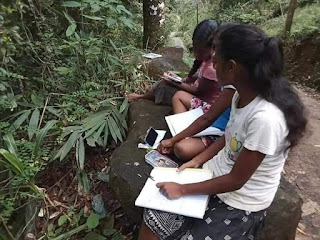
These photos shared on the social media show how some students in Baduraliya in Kalutara district of the Western Province difficultly catch signal to participate in an online lesson.

Subscribe to:
Comments (Atom)
White handkerchief marks protest against forcible cremation by the government of Sri Lanka
Sri Lankan civil society is silently but strongly marking their protest against the government's inhuman forcible cremation of a 20-da...

-
( Lanka Polity - J uly 20, 2009) Automatic Weather Stations (AWS) system provided to the Department of Meteorological by Japan (JICA) follow...
-
 Dr. Janaki Vidanapathirana, Acting Director, National Cancer Control Programme points out that around 23,000 people are diagnosed with cance...
 -
 (January 19, Colombo - Lanka Polity) We re-publish this AFP report that was posted from Washinton since it is an insight into the diplomati...
