(July 17, 2009) The websites the Sri Lanka government accuses of 'slinging mud' at it will face a situation that they 'will be automatically shut down.'
Media spokesman on National Security Minister Keheliya Rambukwella made the warning as reported by the defense reporter of the state-owned Dinamina Sinhala daily.
A team of the Criminal Investigation Department (CID) led by Deputy Inspector General Nandana Munasinghe has started identifying such websites using multiple technologies since yesterday according to the newspaper report.
Lanka News Web, a website accused by the government politicians and the pro-government media of 'slinging mud at the government' cannot be accessed from Sri Lanka since July 11. However, the Minister of Information and Media Anura Priyadarshana Yapa denies any involvement of the government in such filtering. Pro-LTTE Tamilnet website is also blocked since years and the government does not admit the responsiblity of that act too.
Sri Lanka Telecom, a company with 51% state stake is the major internet service provider in Sri Lanka.
(In the map above, the countries in black are the most heavily censored nations regarding internet access. The countries in green maintain a surveillance; the countries in yellow have some sensorship while the blue countries have no censorship.)
(July 16, 2009) The 10th annual awards ceremony to honor excellence in journalism jointly organized by Sri Lanka Editors' Guild and the Sri Lanka Press Institute was held on Tuesday (24) in Mount Lavinia Hotel with much grandeur but turned out to be a farce as the internationally recognized investigative journalist and slain founder editor of The Sunday Leader, Lasantha Wickrematunge was completely forgotten at the event.
A minute’s silence was observed in memory of all the journalists who died during the past year. Reliable sources said that the Editors' Guild was reluctant even to mention Lasantha Wickramathunga's name in the function.
Reportedly, the organizers of the event collected material from Leader Publications Pvt Ltd prior to the event with a promise of a small video presentation on the life and times of Wickrematunge, a pledge never accomplished. Reliable sources say that the Editors' Guild is in the view that the Sunday Leader is not a quality publication, and does not stand by standard journalism ethics. The organizers of the journalism awards ceremony did not accept nominations from the Sunday Leader and Morning Leader, last year and this year. However, Mohanlal Piyadasa the editor of Irudina, the Sinhala language sister paper of Sunday Leader, is an executive committee member of the Editors' Guild. Irudina depends highly on the translations of investigative reports of the Sunday Leader. Regarding ethics, no other Sri Lankan newspaper is better than the Sunday Leader, according to our point of view. If the Leader is notorious in war reporting, the other newspapers are notorious in many other criteria like gender, ethnic and religious biases etc.
Lasantha Wickrematunge was murdered in broad day light on a busy highway on January 08, 2009 as he was driving his vehicle to the newspaper office. Editors' Guild praised him in their obituaries although it took a different stand at the journalism excellence awards ceremony. It said that what the country was witnessing was an ongoing campaign against the dissemination of information to the citizenry and democratic dissent. “An adversarial relationship between any government and the media is good for governance and Lasantha epitomized this. It is also the inalienable right of the people to be kept informed and to decide on the choice of media,” the Editors’ Guild said then.
However, the N. Vidyathran, the Editor of Tamil publications, Uthayan and Sudar Oli and his staff were honored at the ceremony for reporting under special circumstances. A posthumous award was offered on MTV/MBC correspondent Rashmi Mohammed who was killed in a bomb attack on October 6, 2008 at Akuressa while covering a political meeting.
Sri Lankan Minister of Labor Mervyn Silva has meanwhile publicly claimed responsibility for ‘eliminating’ Lasantha Wickrematunga while the President Mahinda Rajapakse said to The Hindu Editor-in-chief N. Ram during an interview that Lasantha Wickramathunga was friend and the deceased had made his last call was made to the President. He said he was unable to reply it since he was in shrine room at the moment.
(July 15, 2009) The special Commission of Inquiry into alleged human rights abuses in Sri Lanka submitted an incomplete report to the President and wound up its operations.
The commission chaired by the retired Supreme Court Judge Nissanka Udalagama exonerated Army from the allegations leveled against them by various sections including the Sri Lanka Monitoring Mission and the Jaffna University Teachers for Human Rights regarding the killing of 17 employees of the French NGO named Action Against Hunger (ACF) in Muttur and the killing of five students in Trincomalee in 2006. But the probes did not extend to investigate the perpetrators of the crimes.
The commission admits the investigation is incomplete and recommends the President to probe the incidents further. Udalagama said to the BBC that it lacked resources for video conferencing with the witnesses that have sought asylum in foreign countries. The commission did not record evidence of one eye witness who escaped from death in the student massacre of Trincomalee. One woman laborer who was the last to visit the ACF office before the massacre and a policeman who had seen the whole episode were not testified. These persons have obtained political asylum in foreign countries now. Udalagama also said that the commission had no adequate time for the investigation.
"With regard to the disappearance of Rev. Nihal Jim Brown at Allaipidi in August 2006, inspite of all the effort we were unable to find his body or find anyone who saw the body. An inquiry into it would have become a futile exercise because we cannot recommend it to the High Court because the Court will not take up a case where there is no body," the Chairman of the commission said to Sunday Times on June 21.
The government appointed this presidential commission and an International Independent Group of Eminent Persons (IIGEP) to assist and monitor the presidential commission due to international pressure on the spate of serious human rights violations. IIGEP was a group of individuals nominated by international donor countries and the government of Sri Lanka, vested with a wide mandate to observe all investigations and inquiries conducted by and on behalf of the Commission of Inquiry into alleged human rights abuses in Sri Lanka. The following individuals were members of the IIGEP: The IIGEP chaired by former Chief Justice of India P.N.. Bhagawathi questioned the independence of the commission and the members resigned prematurely terminating its operations in April 2008. Since then the commission lacked luster and no one seemed looking forward for a remarkable outcome from the commission.
"In an IIGEP press briefing On April 22 2008, three members of the IIGEP clarified matters relating to their resignation. Sir Nigel Rodley characterized some of the communications to the IIGEP, including to its chairman as 'very disrespectful', and added that the latest AG response to the April 14th IIGEP public statements contained baseless allegations that the IIGEP were working according to a secret agenda in order to force UN Human Rights Monitoring onto Sri Lanka in defiance of Sri Lankas sovereignty. The IIGEP Chairman, P.N. Bhagwati, outlined that the allegations that the IIGEP did not understand the Sri Lankan legal system were irrelevant, as IIGEPs mandate calls for the group to comment on whether the proceedings conform to international standards, not Sri Lankan standards. Professor Yozo Yokota reminded the press corps that, contrary to government statements, the IIGEP is not a European group, but consists of experts from all over the world.
Main concerns of the IIGEP were as follows:
A lack of political will from the Government of Sri Lanka to support a search for the truth.
A conflict of interest in the proceedings before the Commission, with officers from the Attorney General playing an inappropriate and impermissible role in the proceedings.
Lack of effective victim and witness protection
Lack of transparency and timeliness in the proceedings
Lack of full cooperation by State bodies
Lack of financial independence of the Commission"
(Wikipedia)
The term of the commission came to an abrupt end in June with hearings into only seven cases concluded.
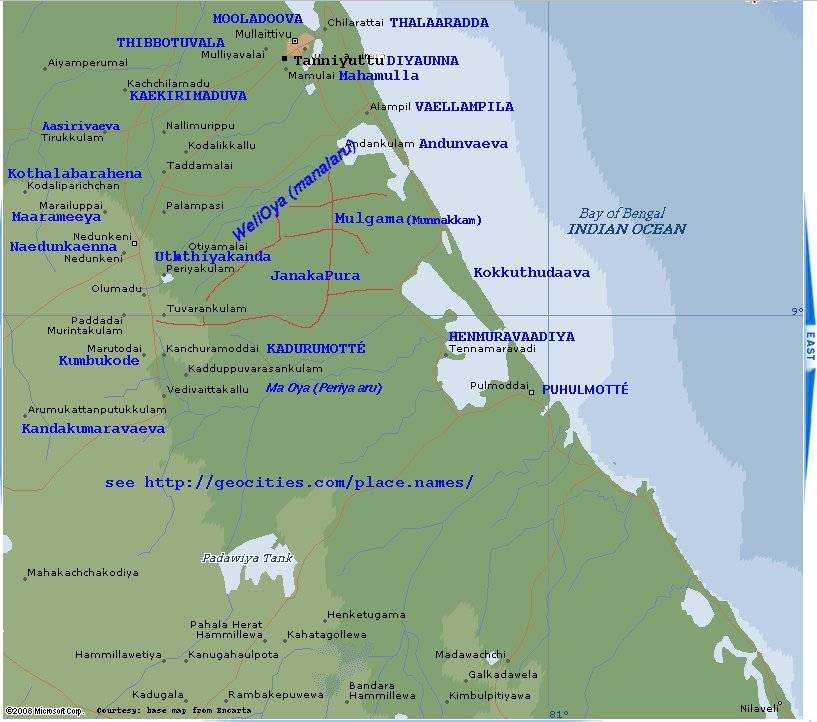
(July 14, 2009) The Director General of Sri Lanka Mahaweli Authority Dharmasiri de Alwis has told the state-owned Dinamina newspaper today that 2500 families will be settled in Nedunkarni in Mullaithivu district under the Welioya project of the Mahaweli L-zone. Each family will be granted one acre for paddy cultivation, half an acre for coconut growing and one acre for the home garden.
Nedunkarni is a Tamil dominated area centered by a small town and the residents are now internally displaced in camps in Vavuniya. Dinamina report does not mention anything about the ethnicity of the settlers in the new colonies.
We consider this as a very sensitive political issue that should be handled with utmost care. Mahaweli Authority should not be the sole competent authority in this regard.
The idea that the Sinhala invaders are colonizing their land is one of the basic tools manipulated by the Tamil nationalists to fuel the passion on the homeland among Tamils. This phenomenon presented as Sinhala colonization was vehemently resisted by Tamils.
In the early colonization process, the traditional dwellers of the lands as such in Galoya etc. were integrated to the new colonies. The ethnic ratio among the settlers was also considered. But this situation gradually changed later.
In the late 1950s, Pihimbiyagollewe Dhammaloka Thero, a young Buddhist monk who had settled in Padaviya blocked Tamils being settled in the Eastern parts of the Padaviya colony with the auspices of the Sinhala politicians. Entire Padaviya settlement was tuened to a Sinhala colony and later in 1980s the traditional Tamil villagers like Thennamaravadi in the Eastern coast off Padaviya were also wiped out.
Through this process, a wall of Sinhala villages was erected in between the Northern and Eastern Provinces. It can be observed that the colonization process in the age of the D.S. Senanayaka aimed at undermining the separatist trends among the minorities. But the late colonization were attempts to spread Sinhala chauvinism.
Herman Malinga Bandara, a civil servant engaged in colonization in Welioya has clearly hinted in his book ‘For a sovereign State' that Sinhala chauvinist interests were behind the setting up of Welioya colony in the northeastern parts of Sri Lanka.
Before Welioya colony was set up, this area was dominated by the farms like Dollar, Kent and Ceylon Theaters Farm etc. that were set up in long leased crown land. An NGO called Gandhiyam Movement had settled some Tamils that had been displaced from the southern parts of the island due to ethnic violence in the abandoned land of these fams. Militant groups like PLOTE led by Uma Maheswaran were also active among these displaced persons. Ill-famous Dollar and Kent Farm massacres of Sinhala settlers and the retaliatory massacre of Tamil villagers in nearby Othiyamale were a beginning of a new era of bloodshed in this zone that took hundreds of lives of Sinhala and Tamil peasants.
Welioya was later earmarked as Mahaweli L-zone. Under the original plan, 39,000 hectare land belonged to Anuradhapura, Vavuniya and Mullaithivu administrative districts were divided into six zones. They include Sampathnuwara, Janakapura, Kokilai, Nedunkarni and Nayaru areas but only two zones were developed so far, say the Mahaweli Authority. The other zones could not be developed due to the unsafe conditions. There are settlements in Nikaweva, Ehetugasweva, Kiribbanweva, Janakapura , Kalyanipura, New Monaraweva and New Gajabapura areas. People were settled in some other areas of Gajabapura, Monaraweva, Helambaweva, Kambiliweva, Konweva, Veheraweva and parts of Kalyanipura but they vacated those areas due to security concerns.
Mahaweli Authority says that 5000 families were settled in Welioya area during the past 22 years. 3364 of them were settled in legally allocated land and the others were squatters. They were leaving and coming back time to time due to security issues.
(July 14, 2009) The International Federation of Journalists (IFJ) is shocked at a recent article posted on the website of Sri Lanka’s Ministry of Defence, branding as “traitors” five lawyers appearing in a case of contempt involving the Sunday Leader newspaper.
The article, titled “Traitors in Black Coats Flocked Together”, names five lawyers who appeared for the Sunday Leader at a hearing in the Mount Lavinia court near Colombo as having “a history of appearing for and defending” separatist guerillas of the Liberation Tigers of Tamil Eelam (LTTE). The article features pictures of three of the lawyers.
“We have observed in recent times that this manner of public vilification of individuals for being supposed sympathisers of the LTTE has often provoked physical attacks on them by vigilante groups,” IFJ General Secretary Aidan White said.
“The IFJ calls upon the Sri Lankan President to publicly repudiate the sentiment expressed in the article and ensure that it is removed from the official website of the Defence Ministry.”
The Sunday Leader, edited by Lasantha Wickramatunge until his murder in January, has for long been locked in a defamation case brought by Sri Lankan Defence Secretary Gotabaya Rajapakse.
After Wickramatunge’s murder, the newspaper agreed during a hearing of the case that it would not publish material similar to that which had brought the action against it.
The contempt case that the Sunday Leader now faces reportedly involves another report involving the Defence Secretary, though on a different subject.
“It is a principle of natural justice that the newspaper should be able to seek sound advice and be represented by competent legal counsel in this case,” White said.
The IFJ stands by the strong stand taken by its affiliate, the Free Media Movement (FMM), and other professional bodies in Sri Lanka on the matter.
“We urge Sri Lanka’s President to turn the page on the bitterness of the long civil war against the LTTE and actively seek to restore the freedoms that have deteriorated alarmingly in recent years.”
(July 14, 2009) Sri Lanka's opposition political parties are reportedly trying to field an intractable candidate for the upcoming Presidential to challenge the powerful President Mahinda Rajapakse.
Rajapakse is marketing his role as the overall commander of the three armed forces in the war to maintain his power and many political strategists opine that only a person who acted a superior role in war can challenge his candidacy for the Presidency.
It is reported that there is an attempt to bring a figure that acted a major role in war against Liberation Tigers of Tamil Ealam (LTTE) as the common candidate of the opposition in the next Presidential.
A leftist party that acted the role of king maker in the past elections has initiated this move, sources say. Although this party has no strong vote base day, it is very well organized and clever in political campaigns. Some say they can teach the Sri Lankans that the crow is white if they want to do so.
The major opposition is also backing this move, reliable sources say.
Informed sources say that the President has stated that he will hold the Presidential election before the general election and apparently it will be scheduled by the end of this year or the beginning of the next year.


![Reblog this post [with Zemanta]](http://img.zemanta.com/reblog_e.png?x-id=10aef273-0f86-4182-a8af-1f05bc9c3e18)


![Reblog this post [with Zemanta]](http://img.zemanta.com/reblog_e.png?x-id=8ee2e18f-88f2-4890-8f70-6843dd56e33b)

![Reblog this post [with Zemanta]](http://img.zemanta.com/reblog_e.png?x-id=4e304220-1719-48b0-bee9-ee457c1f0e30)


![Reblog this post [with Zemanta]](http://img.zemanta.com/reblog_e.png?x-id=25384dcc-31c5-4e03-895f-6927e9d5dc70)


